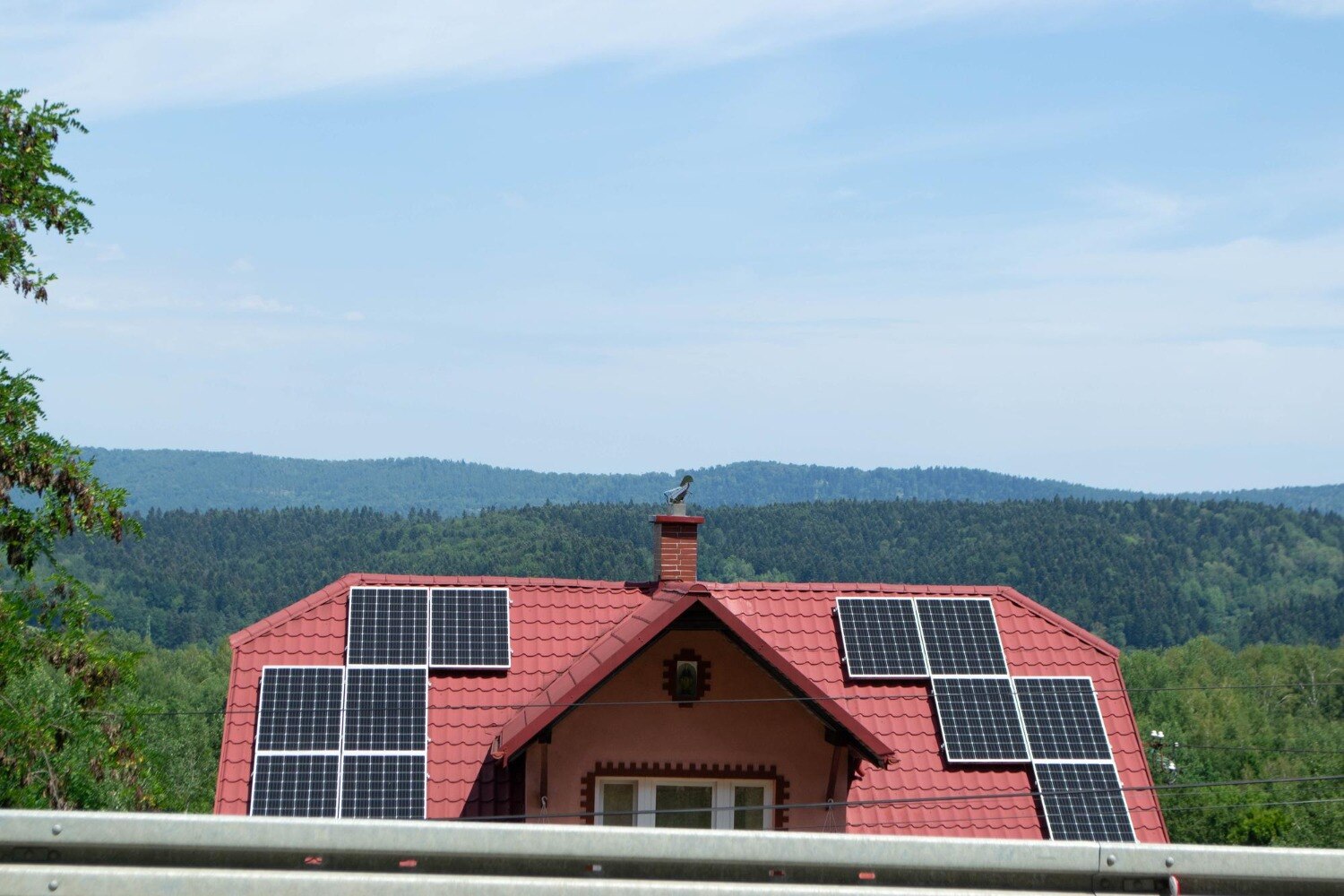
A 540 Wp module can reduce the number of panels on a rooftop, but its nameplate rating does not tell you how much electricity your home will receive each day. By checking your consumption, roof dimensions, shade, inverter limits and utility requirements, you can decide whether this module fits better than a smaller or larger alternative.
Key takeaways
- 540 Wp means 540 watts under laboratory Standard Test Conditions, not constant rooftop output.
- Calculate panel count from your target system size and confirm each panel’s roof footprint.
- Check shade, roof direction, structural capacity and access before approving the design.
- Compare inverter voltage, current, warranty, installation scope and subsidy paperwork in every quotation.
What 540 Wp means on a home rooftop
A 540 Wp Adani solar panel is rated to produce 540 watts only under Standard Test Conditions: 1,000 W/m² irradiance, a 25°C cell temperature and an AM1.5 spectrum. On your roof, it does not deliver 540 watts continuously.
1. Count its capacity correctly. One panel contributes 0.54 kWp to your system, not 540 watts throughout the day. Heat, dust, wiring losses, inverter conversion and shade reduce live output. At a 65°C cell temperature, heat alone can cut crystalline-silicon power by roughly 12–16% when the temperature coefficient is −0.3% to −0.4% per °C.
2. Estimate energy in kilowatt-hours, not by multiplying 540 watts by daylight hours. Using a broad Nagpur planning assumption of 1,400–1,700 kWh per kWp-year, one panel could produce about 756–918 kWh per year before site-specific losses. That is an annual planning range, not a guaranteed daily figure.
3. Judge the home solar panel wattage against your roof, inverter, sanctioned load and electricity consumption. A 540 Wp panel suits a home when those four factors support it; its larger size does not make it commercial-only. Confirm the final estimate with the roof’s orientation, shade, tilt, soiling and system losses.
How many panels and how much roof space you need
Four panels give about 2 kW, or 2.16 kWp; six give about 3 kW, or 3.24 kWp; ten give about 5 kW, or 5.4 kWp; and twelve give about 6 kW, or 6.48 kWp. Round up from your required capacity rather than treating 540 W as continuous output.
Use your electricity consumption to choose home solar panel wattage, then confirm the array, inverter and connection size together. The inverter, mounting structure and utility application must be designed around the complete DC array, not one module.
A typical module footprint is approximately 2.3 m by 1.13 m, or 2.6 m². Ten panels therefore cover about 26 m² of panel surface. The exact Adani model dimensions and weight must come from its model-specific datasheet.
Your usable roof requirement is larger because the layout also needs:
- Row spacing to prevent one row shading another
- Parapet and roof-edge clearance
- Walkways and maintenance access
- Mounting rails and drainage space
- Clearance from tanks, stair rooms and other obstructions
A quotation showing only 26 m² for ten panels understates the real roof requirement: it measures glass, not the working installation. Ask for the final module layout with access routes and clearances marked.
A 540 watt Adani solar panel for home use can weigh approximately 27–30 kg. Check lifting access, roof loading and the structure before approving the installation; a narrow staircase or weak roof slab can change the practical choice even when the panel count fits.
Check whether your Nagpur roof will work
Your Nagpur roof works only if you count usable, unshaded space—not the total slab area. Measure the unobstructed length and width, then mark parapet walls, water tanks, solar water heaters, stair rooms, trees and nearby buildings. Reserve access paths before counting modules.
- Treat south-facing placement as a useful starting point in Nagpur, not an automatic guarantee. Require a site-specific azimuth and tilt assessment.
- Check winter shadows separately: parapet shadows become longer, and a chimney or tree can affect a string even when only part of one module is shaded.
- Bypass diodes reduce hot-spot risk; they do not make a shaded panel perform normally.
- Compare the approximately 2.3 m by 1.13 m footprint and 27–30 kg handling weight with each clear roof section. Confirm exact dimensions from the Adani datasheet.
A 540 watt solar panel in Nagpur can save roof space overall, but it may fail to fit the only unshaded rectangle.
| Roof condition | Advantage of 540 W modules | Main problem |
|---|---|---|
| Open rectangular roof | Fewer modules and simpler rows | Still needs spacing, edges and walkways |
| Divided roof sections | Higher capacity per module | One module may not fit a narrow section |
| Irregular or shaded roof | Fewer mounting points | Smaller modules may produce a better layout |
Request a shade study showing seasonal shadows, row spacing, access routes and the final module layout. Reject a plan that lists only panel surface area without showing those clearances.
Match the module to the inverter before buying
A 540 watt Adani solar panel for home use is compatible only when its exact model matches the inverter. Request the model-number datasheet, not a generic 540 W sheet. High-wattage modules can carry more current than older 330–400 W panels, so nominal wattage proves little.
Ask the installer to compare:
- Module Voc and Vmp with the inverter’s maximum DC voltage and MPPT operating-voltage range.
- Module Isc and Imp with the inverter’s short-circuit-current allowance and maximum MPPT current.
- Series-string count with the inverter’s number of MPPT trackers and recommended PV capacity.
Panels in series add voltage; parallel strings add current. Check the highest cold-weather Voc against the inverter limit, then check hot-weather Vmp and Imp against the MPPT range and current limits.
| Option | 5 kW example | Main trade-off |
|---|---|---|
| 13 × 400 W | 5.2 kWp | Easier lifting and replacement; more roof area and more modules |
| 12 × 450 W | 5.4 kWp | Middle ground for roof fit, handling and shade layout |
| 10 × 540 W | 5.4 kWp | Fewer modules; larger, heavier panels and fewer replacement matches |
| 10 × 550 W | 5.5 kWp | Highest DC capacity here; confirm roof fit, current and availability |
The quotation must state the DC-to-AC ratio and estimated inverter clipping. Moderate oversizing can improve annual inverter use, but undisclosed clipping hides the design trade-off. A 540 Wp Adani solar panel is not automatically better if a fragmented roof, difficult lifting route, shade pattern or future replacement plan favours smaller modules.
Make the final decision with the right quotation
Choose 540 Wp when fewer modules solve a roof-space problem, the structure can carry larger panels, the inverter accepts the module’s current and voltage, and the layout remains unshaded. A 540 watt solar panel in Nagpur is not automatically the best choice for a small or irregular roof.
| Choice | Choose it when | Main compromise |
|---|---|---|
| 540 Wp | You have a broad, accessible roof and want fewer modules | Larger, heavier panels make lifting, replacement and tight layouts harder |
| 400–450 W | Access is narrow, the roof is fragmented, shading needs flexible string design, or replacement compatibility matters most | More modules and more mounting area |
For any adani solar panel for homeowners, require the exact model-specific datasheet, serial-number traceability, product warranty, performance warranty, fire classification, mechanical-load rating and IEC documents. The quotation must identify monofacial or bifacial construction; bifacial gain depends on rear-side albedo, mounting height and roof clearance, so close-mounted roofs may deliver little extra rear-side generation.
Before applying for subsidy, confirm current PM Surya Ghar eligibility, registered-vendor rules and domestic-content requirements. Also verify Maharashtra’s live distribution-utility process for approval, metering, synchronization and commissioning.
RDC INFOTECH can help compare a Nagpur roof survey with an installation quotation, but ask for every electrical, structural, generation and subsidy assumption in writing before paying. A panel’s Indian brand name alone does not prove scheme eligibility.
Related product
 | Solar Panel 540 WP, 545 WP, 555 WP Adani Solar Panels MBB cell technology with 10BB, smart soldering MBB cell technology with 10BB, smart soldering MBB cell technology with 10BB, smart soldering Maximum... View product → |
Frequently asked questions
What does 540 Wp mean on a home rooftop?
540 Wp is the panel’s rated output under Standard Test Conditions: 1,000 W/m² irradiance, 25°C cell temperature and an AM1.5 spectrum. Rooftop output changes with heat, shade, dust, orientation and wiring losses.
How many 540 Wp Adani panels does a home need?
Divide your target solar capacity in watts by 540 and round up to a whole panel. Confirm the result against your electricity use, available roof area and the inverter’s permitted DC input.
Will a Nagpur roof work for a 540 Wp solar panel?
Check unshaded roof area, direction, tilt, structural strength, drainage and safe maintenance access. A site survey should also identify shadows from tanks, parapets, trees and nearby buildings.
What should you compare in quotations for a 540 Wp Adani panel system?
Compare the exact module model, panel count, inverter ratings, mounting structure, protections, cabling, earthing, warranties, installation scope and subsidy documentation before choosing.
Keywords