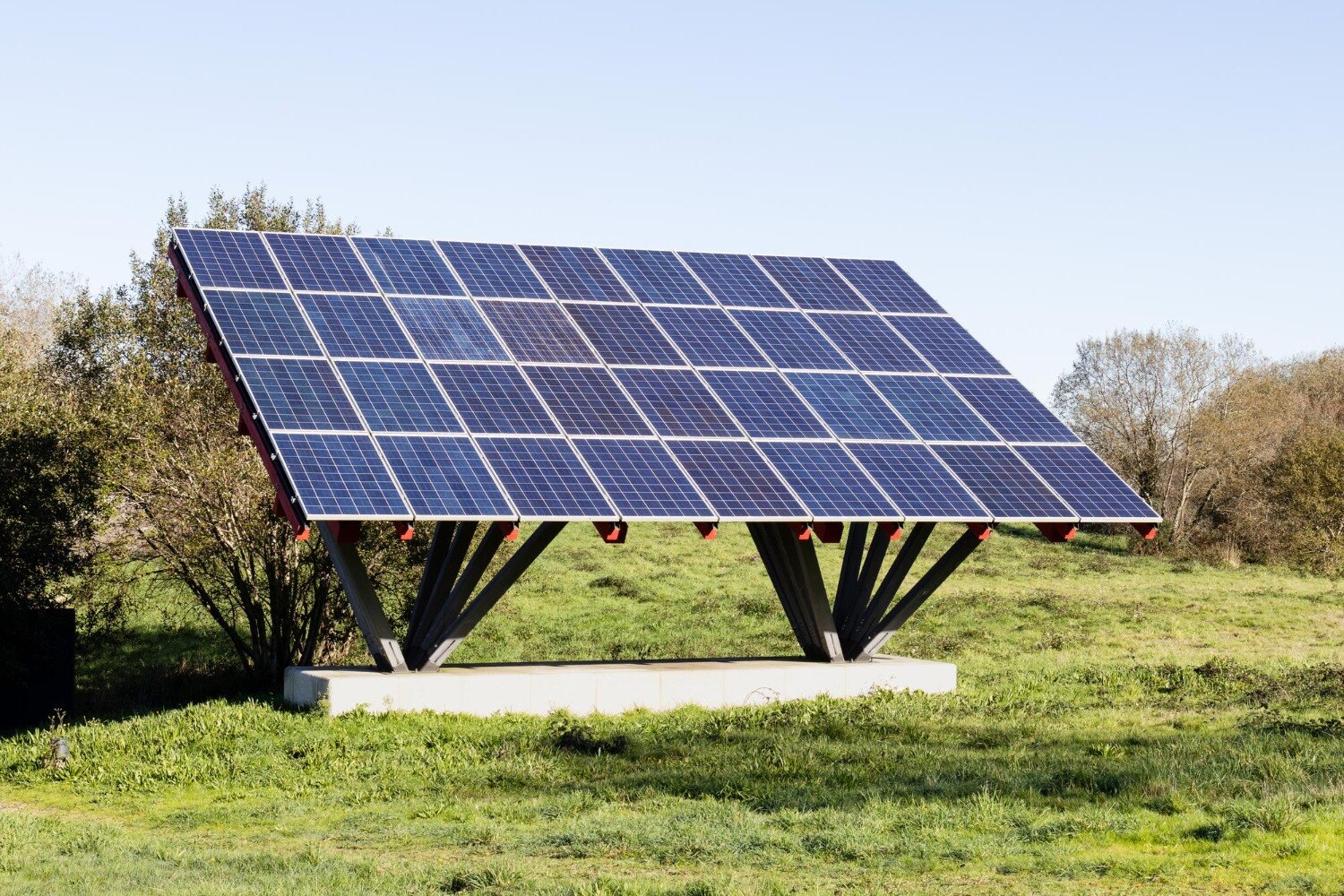
The 540 Wp, 545 Wp and 555 Wp figures describe a panel’s rated maximum DC output under laboratory conditions, not the electricity your home receives every hour. By the end, you will be able to compare the three ratings, calculate panel counts, check roof and inverter compatibility, and identify the documents needed before approving a Nagpur installation.
Key takeaways
- Wp is the panel’s maximum DC rating under laboratory STC conditions.
- A 1 kW system needs two 540–555 Wp panels after checking local rules.
- Match inverter voltage, current and MPPT limits to the panel datasheet.
- Ask for the exact model number, warranty terms and subsidy paperwork before approving.
What Wp Means on a 540, 545 or 555 Watt Panel
Wp means watt-peak: the panel’s rated maximum direct-current output under Standard Test Conditions (STC)—1,000 W/m² irradiance, a 25°C cell temperature and AM1.5 spectrum. It is not continuous household output or guaranteed production on a Nagpur roof.
The search phrase “540 545 and 555 watt adani for solar panel meaning in nagpur” therefore describes nameplate capacity, not your bill savings.
| Rating | Difference from 540 Wp | Ten-module DC array |
|---|---|---|
| 540 Wp | Baseline | 5.40 kWp |
| 545 Wp | 5 W higher, about 0.9% | 5.45 kWp |
| 555 Wp | 15 W higher, about 2.8% | 5.55 kWp |
A 545 watt adani solar panel does not automatically produce more annual energy than every 540 Wp panel. Dust, heat, shade and inverter losses affect rooftop generation. The inverter’s AC rating and actual annual kWh remain separate from the array’s kWp.
The headline wattage alone does not tell you the module’s efficiency, temperature coefficient, dimensions, weight, voltage, current, or whether it is monofacial or bifacial. Obtain the exact model code and datasheet before comparing panels; two modules with the same Wp rating may not fit the same roof or inverter.
How Many Panels Do You Need for a 1 to 5 kW System?
Two panels are enough for a nominal 1 kW system, but the array will exceed 1 kWp because modules are sold in discrete ratings.
| System size | 540 Wp modules | 545 Wp modules | 555 Wp modules |
|---|---|---|---|
| 1 kW | 2 panels = 1.08 kWp | 2 panels = 1.09 kWp | 2 panels = 1.11 kWp |
| 2 kW | 4 panels = 2.16 kWp | 4 panels = 2.18 kWp | 4 panels = 2.22 kWp |
| 3 kW | 6 panels = 3.24 kWp | 6 panels = 3.27 kWp | 6 panels = 3.33 kWp |
| 5 kW | 10 panels = 5.40 kWp | 10 panels = 5.45 kWp | 10 panels = 5.55 kWp |
The final array need not equal the nominal system size. The designer balances DC array capacity with inverter limits, sanctioned load, interconnection conditions and utility or subsidy rules. This is why solar panel wattage for home in Nagpur cannot be selected from the electricity bill alone.
Higher-wattage modules reduce panel count and some rail and clamp work. Larger modules can be harder to carry through stairwells, fit around tanks and parapets, or replace individually.
- Calculate module footprint from the exact model’s length × width × panel count.
- Add mounting clearances, access paths, setbacks and maintenance space.
- Do not treat that multiplication as the complete roof area. A 555 watt adani solar panel may need a different layout from a 540 Wp model.
Which Datasheet Numbers Must Match the Inverter?
A 540, 545 or 555 Wp label does not identify the electrical values an inverter needs. Request the exact model number and current datasheet; a 545 watt Adani solar panel is not automatically interchangeable with another 545 Wp module.
| Parameter | Datasheet figure to compare |
|---|---|
| Pmax | Rated maximum power |
| Efficiency | Module conversion percentage |
| Dimensions | Length, width and thickness |
| Weight | Module mass for roof and structure |
| Power tolerance | Permitted output variation |
| Voc | Open-circuit voltage |
| Vmp | Maximum-power voltage |
| Isc | Short-circuit current |
| Imp | Maximum-power current |
In a series string, panel voltages add while current remains close to one panel’s value. In parallel strings, current adds while voltage remains similar. Compare both results with every inverter MPPT’s operating-voltage range, operating-current limit, maximum DC voltage, total input-current limit and each panel’s maximum-series-fuse rating.
Voc rises on a cold morning, so check the coldest expected start-up temperature. Hot-cell voltage and power must also remain suitable for Nagpur’s hottest operating days, using the datasheet temperature coefficients.
Before commissioning, verify:
- DC isolators and correctly sized cables
- Earthing continuity
- Surge-protection devices
- String voltage and current calculations
The 540, 545 or 555 Wp label alone proves none of these matches.
Why Nagpur Roof Conditions Change the Rated Output
A 540-watt Adani solar panel in Nagpur will produce less than its STC rating when hot. Compare the selected datasheet’s maximum-power temperature coefficient: high cell temperature, dust and partial shade from tanks, parapets, trees or buildings reduce output.
| Factor | Effect on annual generation | Check |
|---|---|---|
| Temperature | Hot cells reduce power below STC | Compare maximum-power temperature coefficient |
| Shade, orientation and tilt | A shaded row or poor roof angle can outweigh 15 W | Record shadows through the day and seasons |
| Mismatch, inverter and cable losses | Connected components reduce delivered AC energy | Request itemised loss assumptions |
| Degradation | Output declines over the warranty period | Check first-year and annual degradation figures |
For solar panel wattage for home in Nagpur, survey the shadow-free roof area, then use the exact quoted panel dimensions and weight. Add mounting-structure space, setbacks, access gaps and a shade-free maintenance corridor. Check wind loading, roof strength, lifting access, and stairwell or roof-door dimensions.
Compare estimated annual kWh and stated loss assumptions, not only kWp. A 15 W nameplate difference can matter less than poor layout. Choose the higher-wattage module only when its size, weight, voltage and current suit the roof and inverter; otherwise it is the wrong choice.
How to Choose Solar Panel Wattage for a Home in Nagpur
Choose solar panel wattage for a home in Nagpur by sizing the complete system, not by chasing the largest label.
- Collect the latest 12 months of electricity bills and monthly units, then set your desired offset.
- Measure usable, shadow-free roof area and check structural capacity.
- Confirm sanctioned load, DISCOM interconnection conditions and subsidy-category limits.
- Size the inverter and DC array together, checking MPPT voltage and current limits.
540, 545 and 555 Wp are alternative module ratings, not separate household solar categories.
| Rating | Difference from 540 Wp | Practical comparison |
|---|---|---|
| 540 Wp | Baseline | More modules for the same array |
| 545 Wp | 5 W, about 0.9% higher | Slightly fewer modules |
| 555 Wp | 15 W, about 2.8% higher | Fewer modules, if roof and inverter permit |
Choose by annual kWh, efficiency, temperature coefficient, roof fit, MPPT limits and installation access. Compare module count, rails, mid and end clamps, DC connectors, string connections, transport and roof-lifting work; a larger panel can be harder to carry or replace.
Domestic subsidy depends on the sanctioned system category, current government rules, approved equipment and application process—not panel wattage alone. Request the model’s product and performance warranties, first-year and annual degradation, claim process and serial-number requirements in writing. “540 watt Adani solar panel in Nagpur” is incomplete without the exact model code and datasheet.
The Checks to Complete Before Approving a Quotation
A 555 watt adani solar panel is not approved by wattage alone. For the “540 545 and 555 watt adani for solar panel meaning in nagpur” question, request these documents before accepting the price:
1. Confirm the exact model code and current datasheet. Check Pmax, Voc, Vmp, Isc, Imp, efficiency, dimensions, weight, power tolerance, monofacial or bifacial construction, operating-temperature coefficient, maximum system voltage, maximum series-fuse rating, connector type, fire classification and certified test standards. Obtain product and performance warranty documents.
2. Require a roof layout showing module footprint, access paths, setbacks, shade analysis, mounting arrangement and structural assumptions. A generic panel rectangle can leave no maintenance route or overload a weak roof.
3. Require the inverter model, MPPT voltage and current limits, string diagram, cable sizes, DC isolator, earthing and surge-protection plan. Ask for estimated annual kWh and every loss assumption, including shade, temperature, mismatch, cables and inverter conversion.
RDC INFOTECH can help a Nagpur homeowner translate the selected Adani model, roof survey and inverter design into a comparable quotation. Still verify the datasheet, subsidy category and technical design before commissioning or utility approval.
Related product
 | Solar Panel 540 WP, 545 WP, 555 WP Adani Solar Panels MBB cell technology with 10BB, smart soldering MBB cell technology with 10BB, smart soldering MBB cell technology with 10BB, smart soldering Maximum... View product → |
Frequently asked questions
What does 540, 545 or 555 Wp mean on an Adani solar panel?
Wp means watt-peak, the panel’s rated maximum direct-current output under Standard Test Conditions: 1,000 W/m² irradiance, 25°C cell temperature and AM1.5 spectrum. It is not guaranteed continuous output on a Nagpur roof.
How many 540, 545 or 555 Wp panels do you need for a 1 to 5 kW system?
A 1 kW system needs two panels because one panel is below 1 kW. A 2 kW system needs four, a 3 kW system needs six, a 4 kW system needs eight and a 5 kW system needs ten when using panels in this wattage range. Confirm the final DC size, inverter rating and local approval requirements before ordering.
Which panel datasheet numbers must match the inverter?
Compare the panel’s Voc, Vmp, Isc and Imp with the inverter’s maximum DC voltage, MPPT operating-voltage range, maximum input current and maximum short-circuit current. Check the cold-weather string voltage and the number of panels connected to each MPPT.
Why can a Nagpur roof produce less than the panel’s rated wattage?
The rating uses STC conditions, while roof output changes with cell temperature, dust, shading, cable losses, inverter losses, panel orientation and tilt. High cell temperatures reduce voltage and therefore power.
How should you choose solar panel wattage for a home in Nagpur?
Start with your electricity consumption, available unshaded roof area, sanctioned load, inverter size and budget. Compare the complete system’s output, warranty and installation design rather than choosing a panel from its wattage alone.
Keywords