The 625 Wp module produces only about 2.46% more nameplate capacity than a 610 Wp module, so the higher number alone does not decide an off-grid purchase. You will be able to compare the exact panels, size the array and battery for Nagpur conditions, and check whether a quotation delivers usable backup rather than only an attractive Wp figure.
Key takeaways
- A 15Wp difference rarely decides the system’s total output or cost.
- Size panels from daily energy use, peak load and required battery autonomy.
- Check roof area, shade, inverter voltage, battery capacity and cable ratings.
- Demand module specifications, warranty terms, subsidy scope and commissioning details in writing.
625 Wp versus 610 Wp: what actually decides the choice
A 625 Wp or 610 Wp Adani solar panel for an off-grid project in Nagpur should be judged by the complete design, not the larger label. Both ratings come from Standard Test Conditions: 1,000 W/m² irradiance, 25°C cell temperature and AM1.5 spectrum.
The 625 Wp module adds only 15 W, or about 2.46%, over 610 Wp.
Compare the exact model datasheets before choosing:
| Item | What to compare |
|---|---|
| Physical fit | Length, width, thickness, weight and mounting-hole layout |
| Electrical output | Voc, Vmp, Isc, Imp and maximum system voltage |
| Heat behaviour | Voltage and power temperature coefficients |
| Construction | Bifaciality, connector type and cable length |
| After-sales cover | Product warranty, power or degradation warranty, exclusions and claim process |
A 625 Wp Adani solar panel in Nagpur is worth the premium only when its extra output fits the roof, mounting structure and inverter design, and the additional price is justified. Confirm that its current does not exceed the MPPT, fuse or cable ratings.
A 610 Wp Adani solar panel in Nagpur can be the better buy when its smaller footprint, lower operating current, local availability or lower cost simplifies the system. For either option, check hot-weather voltage loss and battery requirements; the 15 W difference does not create overnight autonomy.
How many panels does a Nagpur off-grid project need?
Do not divide 12 kWh by 625 or 610. Size off grid solar panels in Nagpur from loads, storage, losses and controller limits.
- Lights: 250 W × 8 h = 2.0 kWh; starting watts 250.
- Fans: 300 W × 8 h = 2.4 kWh; starting watts 500.
- Refrigerator: 150 W × 10 h = 1.5 kWh; starting watts 900.
- Pump: 750 W × 2 h = 1.5 kWh; starting watts 2,250.
- Computers and router: 300 W × 5 h = 1.5 kWh; starting watts 500.
- Steriliser and miscellaneous: 700 W × 4.4 h = 3.1 kWh; starting watts 1,000.
Daily demand is about 12 kWh. A 3 kW peak load with motor and compressor surges needs a 5 kW inverter with at least 8 kW surge capacity, not merely 3 kW.
Rough assumption: five peak-sun-hours and 75% delivered system efficiency. Required array = 12 ÷ (5 × 0.75) = 3.2 kWp, before extra recovery margin.
Choose a 48 V LiFePO4 battery, 80% usable depth of discharge: two cloudy days require 24 kWh usable, or about 30 kWh nominal, subject to battery temperature, ageing and inverter losses. Include battery charging, inverter, wiring, mismatch, dust and temperature losses.
| Array | Total nameplate | Practical reading |
|---|---|---|
| 6 × 625 Wp | 3.75 kWp | More recovery margin |
| 6 × 610 Wp | 3.66 kWp | 90 W less margin |
Test a 3-series, 2-parallel layout against MPPT voltage, current and power limits using the exact datasheet. Battery capacity, inverter surge rating and cloudy-period recharge—not the small difference between a 625 Wp or 610 Wp Adani solar panel for off-grid project in Nagpur—control the result.
Nagpur roof conditions can outweigh a 15 W module difference
Nagpur roof conditions can outweigh the 15 W label: hot cells reduce operating voltage, monsoon cloud cover cuts irradiance, and a shaded string can lose more output than the rating difference provides. The same applies whether you are assessing off grid solar panels in Nagpur or a 625 Wp Adani solar panel in Nagpur.
| Condition | What goes wrong | Design response |
|---|---|---|
| Summer heat | Cell temperature rises above 25°C and Vmp falls, reducing usable power. | Use the exact temperature coefficients in the energy estimate. |
| Monsoon cloud | Lower irradiance reduces array output for long periods. | Check battery recharge margin, not only clear-sky production. |
| Dust and access | Dust lowers light transmission; unsafe cleaning leaves panels dirty. | Provide safe access, water, drainage and a cleaning plan. |
| Orientation and tilt | Poor azimuth or tilt reduces annual and seasonal yield. | State the orientation and tilt used in calculations. |
| Parapets, tanks and trees | Partial shade limits current through a series string. | Map shade by time and place shaded modules on separate strings or MPPTs. |
| Roof area | Large-format modules may not fit around edges and equipment. | Measure usable roof space, walkways and maintenance clearances. |
Do not treat bifaciality up to 85% as an 85% energy bonus. It is a rear-side cell or module response figure; rear output needs mounting clearance, row spacing and reflected light from a bright roof or pale ground. A module close to a dark roof gains little.
- Cleaning access and inspection intervals
- Shade assumptions and string layout
- Orientation, tilt and roof-area measurements
Check electrical compatibility, battery autonomy and warranty evidence
A 625 Wp or 610 Wp module will not automatically suit an existing off-grid system. Check the design limits before treating an adani solar panel for organizations or a 610 Wp Adani solar panel in Nagpur as a direct replacement.
- Calculate cold-weather string Voc and keep it below the inverter or MPPT controller’s maximum PV voltage. Hot weather reduces Vmp, but cold-weather Voc sets the safety limit.
- Add Isc and operating current across parallel strings, then compare both totals with the controller, combiner, fuse and cable ratings. Check total PV input power against the controller’s wattage limit.
- Separate nominal battery kWh from usable kWh by allowing for permitted depth of discharge, temperature, ageing, charge limits and inverter efficiency. Lead-acid capacity falls at higher discharge rates; lithium batteries require a correctly sized battery-management system.
- Record the exact model code, nameplate Voc, Vmp, Isc and Imp, serial number and manufacturing date. Obtain the current datasheet and IEC 61215 and IEC 61730 documents where required.
- Treat a 30-year power or degradation warranty separately from the product workmanship warranty. Request exclusions, claim deadlines, installation records, commissioning results, photographs and the authorised warranty route in writing.
A higher Wp label cannot compensate for an undersized battery or incompatible controller. Resolve every limit on paper before purchase.
What an organization should demand in the final quotation
A quote for an adani solar panel for organizations must show whether 610 Wp or 625 Wp means each module or the whole array. For off grid solar panels in Nagpur, insist on a design that proves seasonal loads, not one that merely prints a larger number.
- State module count, exact model codes, manufacturing date and serial-number recording; show series/parallel configuration.
- Name the inverter and MPPT models, maximum PV voltage, maximum PV current and total PV input limit.
- State battery chemistry, nominal kWh, usable kWh, permitted depth of discharge and expected backup hours.
- Identify critical-load priorities, generator or utility interaction, motor-starting surge rating and automatic changeover.
- Specify DC and AC protections, earthing, lightning protection, mounting structure, cable sizes, battery enclosure, ventilation, fire precautions and safe shutdown procedure.
- Include remote monitoring, cleaning access, maintenance frequency and commissioning tests: polarity, insulation resistance, earth continuity, Voc, operating current, battery charge, inverter changeover and load-surge tests.
- Price modules, batteries, inverter, structure, cabling, earthing and maintenance separately; assign replacement responsibility and warranty route for each.
For a school, clinic, farm or communications site comparing a 625wp or 610wp adani solar panel for off grid project in nagpur, RDC INFOTECH can add value through a roof survey, load audit, shade assessment, MPPT compatibility check, cleaning plan and supplied-model documentation.
Choose the configuration that meets backup and service requirements, not automatically the higher Wp label.
Related product
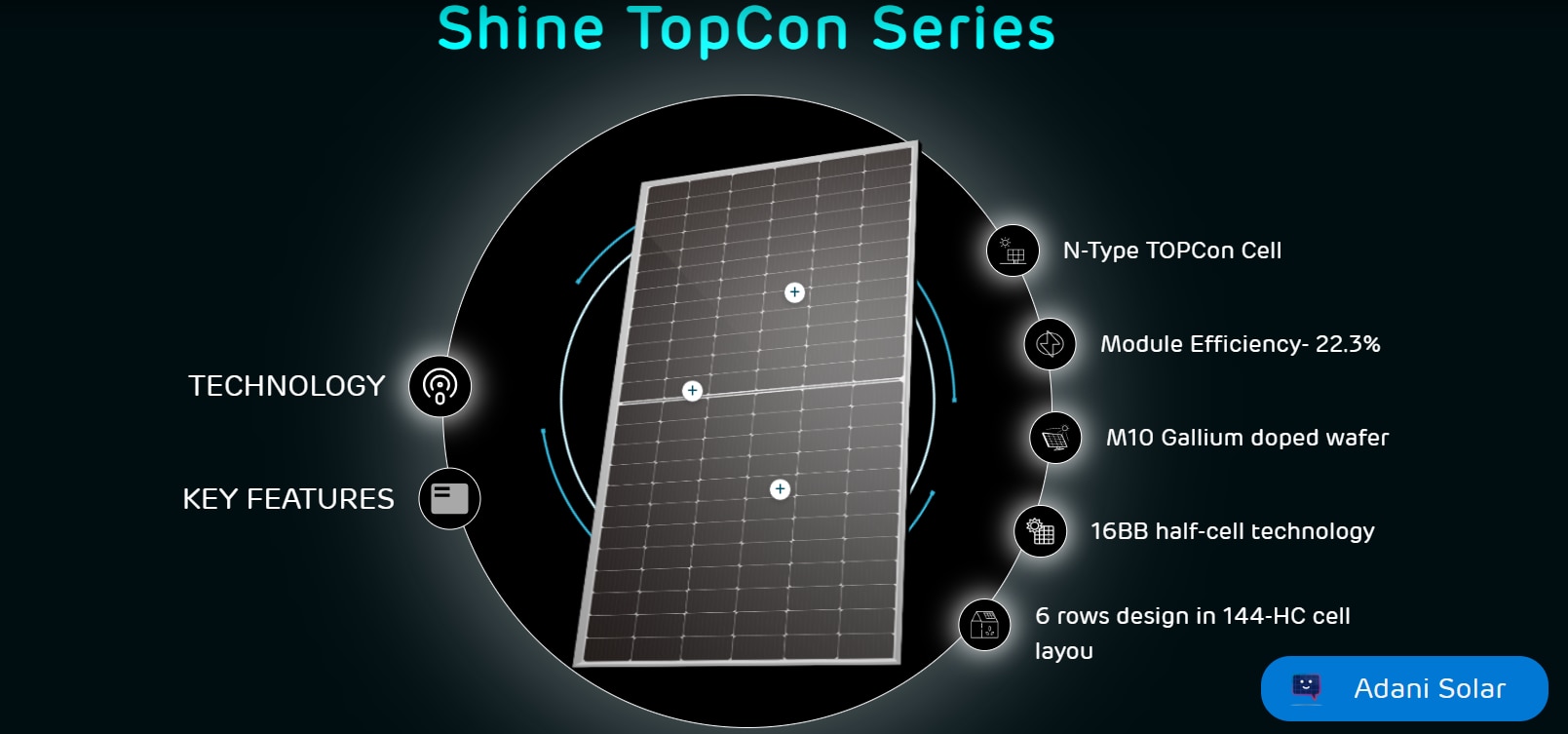 | Solar Panel 625WP, 605WP, 610WP Adani Solar Panel 16 Bus Bar N-Type TOPCon Technology Solar Cells Enhanced Performance during high temperature condition Bifaciality Upto 85% Longer Product life and... View product → |
Frequently asked questions
What actually decides between 625Wp and 610Wp Adani panels?
Compare the complete design: annual energy yield, roof area, shading, module dimensions, inverter compatibility, string voltage, price and warranty terms. The 15Wp nameplate difference alone does not decide the better choice.
How many panels does a Nagpur off-grid project need?
Calculate daily energy consumption, peak demand, local solar yield, system losses and required battery autonomy. Divide the required array capacity by 625Wp or 610Wp, then round up and verify the inverter’s voltage and current limits.
Which Nagpur roof conditions can outweigh a 15Wp module difference?
Limited roof area, parapets, water tanks, nearby trees, dust, orientation and partial shade can reduce output more than the small rating difference. Check the usable roof layout before selecting the panel.
What should an organization demand in the final quotation?
Request the exact module model and datasheet, inverter and battery specifications, array layout, cable and protection details, generation assumptions, warranty documents, installation scope, commissioning tests and payment terms.
Keywords