A housing society can qualify for central assistance when its rooftop solar system serves eligible common facilities, but it cannot automatically claim the same subsidy structure available to an individual residential consumer. By checking the society’s electricity account, sanctioned load, meter category, rooftop rights and proposed system size with the relevant Maharashtra DISCOM, you can determine whether the project qualifies and what savings remain if it does not.
Key takeaways
- GHS and RWA systems can qualify for ₹18,000 per kW under PM Surya Ghar.
- The subsidy limit is 500 kW or 3 kW per household, whichever is lower.
- Use a residential society connection serving eligible common facilities.
- Keep society registration, resolutions, ownership proof and DISCOM documents ready.
Can a housing society apply for rooftop solar subsidy in its own name?
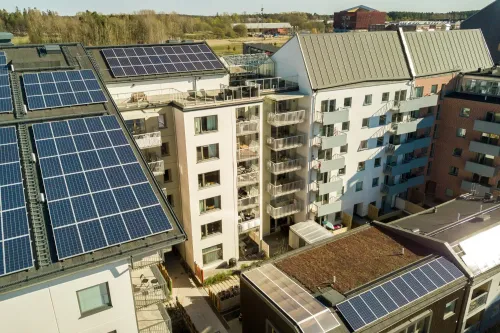
Yes. A cooperative housing society, apartment owners association, Group Housing Society or Resident Welfare Association can apply in its own name for Central Financial Assistance under PM Surya Ghar: Muft Bijli Yojana when the system serves eligible common facilities and the electricity connection meets the scheme’s residential or GHS/RWA conditions.
The applicant is the society or association linked to the common-meter account, not every flat owner. The subsidy supports one common rooftop system for shared consumption, while an individual flat owner applies separately for a system connected to that owner’s residential electricity connection.
| Installation | Applicant and electricity use | Subsidy treatment |
|---|---|---|
| Society rooftop system | Society or RWA; common meter serving shared facilities | GHS/RWA common-facility rules apply |
| Flat-owner system | Individual resident; that flat’s residential meter | Individual residential-subscriber rules apply |
Common loads include:
- Lifts
- Water pumps
- Corridor lighting
- Security systems
- Common EV charging
Do not label a commercial or institutional common meter as domestic solely because residents occupy the building. The serving DISCOM decides how the connection is classified under the scheme, and its records must match the application.
For a housing society solar subsidy in Nagpur, record the roof owner, common-meter account holder and beneficiary in a society resolution. That prevents disputes when one building provides the roof and another pays the common bill. The resulting saving stays with the common account; it does not automatically reduce individual flat bills.
The same checks apply when assessing a domestic rooftop subsidy society in Nagpur.
Which subsidy rate and capacity limit applies to a society?
₹30,000 per kW applies to the first 2 kW of an eligible individual residential connection. The third kW attracts ₹18,000, so the maximum Central Financial Assistance for one individual connection is ₹78,000. The calculation uses eligible solar capacity, not the total invoice value.
| Applicant or use | CFA rate | Capacity or subsidy limit |
|---|---|---|
| Individual residential connection | ₹30,000/kW for the first 2 kW; ₹18,000/kW for the third kW | Maximum CFA of ₹78,000 for systems of 3 kW or more |
| GHS or RWA common facilities | ₹18,000/kW | Common-facility component limited to 500 kW and 3 kW per dwelling unit |
A society-wide plant does not give every flat owner a separate ₹78,000 subsidy. That rate belongs to each qualifying individual residential connection; the society’s common meter uses the GHS/RWA calculation. Eligible shared loads include lifts, water pumps, corridor lighting, security systems and EV charging, subject to scheme and DISCOM conditions.
Apply the 500-kW and 3-kW-per-dwelling-unit limits together. For example, a 100-dwelling society faces a 300-kW dwelling-unit limit, while a larger society still cannot claim CFA beyond 500 kW under the common-facility limit.
Solar subsidy benefits for housing societies in nagpur therefore depend on the connection category, eligible capacity and sanctioned project—not simply on roof size or installation cost.
What electricity connection and meter must the Nagpur society have?
The society needs a consumer connection recorded by MSEDCL, or its actual serving utility, as residential or GHS/RWA use for common facilities. Residents living in the building do not turn a commercial or institutional common meter into a domestic connection.
| Connection type | Subsidy position | What to verify |
|---|---|---|
| Residential flat meter | Individual residential CFA route | The flat owner’s consumer number and meter serve that dwelling, not society loads |
| GHS/RWA common meter | Common-facility CFA route | The account holder, common-area use and dwelling-unit count match the scheme records |
| Commercial or institutional meter | Do not claim it as domestic use | Ask the DISCOM whether category conversion or another eligible interconnection route is available |
For apartment solar subsidy eligibility in Nagpur, obtain the latest electricity bill and check:
- Consumer number, registered account name, tariff or meter category, sanctioned load and supply phase
- Whether lifts, pumps, corridor lights, security equipment and proposed EV charging are supplied through that meter
- Whether the sanctioned load can accommodate the proposed solar capacity and export arrangement
- Whether MSEDCL accepts a bidirectional net meter for that connection, including its current application, testing and inspection requirements
- Whether the roof, inverter capacity, single-line diagram and transformer limits satisfy the utility’s technical review
Net-meter approval and CFA approval are separate. A housing society solar subsidy in Nagpur can fail or be delayed if the common meter is commercial, the consumer details do not match, the sanctioned load is inadequate, or the DISCOM rejects the proposed export configuration.
A utility confirmation in writing is safer than describing the project as a domestic rooftop subsidy society in Nagpur.
How do rooftop ownership, society records and approvals affect eligibility?
Eligibility depends on documented ownership and the eligible electricity account, not simply on having a usable roof. For apartment solar subsidy eligibility in Nagpur, identify the roof owner, common-meter account holder and beneficiary before the society applies; one common plant does not create a separate subsidy claim for every flat owner.
1. Record the roof arrangement in a society resolution. For a jointly owned roof, attach the co-owners’ consent or legally valid authorisation. If several buildings share one project, name the building or entity providing roof space and the entity receiving the common-meter benefit.
2. Match the application to the electricity account. If the meter remains in a developer’s or facilities contractor’s name, obtain an approved transfer, authority, or written arrangement accepted by the serving DISCOM and scheme portal. A contractor who only operates the meter is not automatically the subsidy beneficiary.
3. State the beneficiary clearly: the society, apartment owners association, Group Housing Society or Resident Welfare Association receiving credit on its common account. Residents’ private bills do not receive automatic credits from that account.
4. Apply through the scheme portal with the eligible consumer details, select an eligible or empanelled vendor, obtain DISCOM technical approval, complete installation and inspection, and submit commissioning evidence for subsidy payment. Keep the resolution, ownership consent, consumer number, single-line diagram and bank details consistent; mismatches can delay approval or commissioning.
When does a subsidised or unsubsidised society system make financial sense?
A subsidised system makes financial sense when its CFA reduces the society’s upfront cost without hiding equipment or approval charges. An unsubsidised system can still pay back through lower purchases from the common meter.
| Option | What you compare | Financial effect |
|---|---|---|
| Subsidised common-facility system | Eligible rooftop capacity, GHS/RWA CFA, and net-metered generation | Reduces the initial cost and cuts energy bills for lifts, water pumps, corridor lighting, security systems and common EV charging |
| Unsubsidised system | Full installed price against annual common-meter consumption | Still saves money when daytime loads are large enough to use the generation |
| Battery-based system | Battery, inverter and replacement cost separate from eligible solar capacity | Useful for backup, but battery savings must not be counted as subsidy or ordinary daytime bill reduction |
The saving remains with the society’s common electricity account. It does not automatically reduce each flat owner’s bill, and a plant sized for occasional lift use can leave panels underused.
The phrase solar subsidy benefits for housing societies in nagpur should lead to a calculation, not an assumed discount. A “domestic rooftop subsidy society in Nagpur” quotation must show:
- Gross system price and GST
- Eligible solar capacity and expected CFA
- Panels, inverter, structure and installation included
- Batteries, structural repairs, cable upgrades, meter changes and other excluded items
- Estimated annual generation, common-meter consumption and export arrangement
Ask RDC INFOTECH, or any competing installer, for this written split before appointment; compare it with the society’s last 12 months of common-meter bills and obtain DISCOM approval details separately.
Related product
 | Solar Subsidy Solar Subsidy For Domestic Rooftop Solar System Subsidy available for domestic solar system. . View product → |
Frequently asked questions
Can a housing society apply for rooftop solar subsidy in its own name?
Yes. A cooperative housing society, apartment owners association, Group Housing Society or Resident Welfare Association can apply in its own name under PM Surya Ghar when the system serves eligible common facilities and meets the scheme’s residential or GHS/RWA connection conditions.
Which subsidy rate and capacity limit applies to a housing society?
For Group Housing Societies and Resident Welfare Associations, Central Financial Assistance is ₹18,000 per kW. The eligible capacity is capped at 500 kW, subject to a limit of 3 kW per household, whichever is lower.
What electricity connection and meter must a Nagpur society have?
The society needs a grid-connected residential electricity connection from the local DISCOM, with a consumer account and meter serving the eligible common facilities. Confirm the connection category and sanctioned load with MSEDCL before applying.
How do rooftop ownership, society records and approvals affect eligibility?
Keep proof that the society controls the installation site, along with its registration certificate, PAN, bank details, electricity bill, member or household count and a resolution authorising the project. Obtain any required rooftop, structural and electrical approvals before installation.
When does a subsidised or unsubsidised society solar system make financial sense?
Solar makes stronger financial sense when common-area electricity use is high during daylight, the roof is shadow-free and the system offsets costly grid energy. Compare the installed cost, subsidy, maintenance, inverter replacement, export rules and post-subsidy payback before approving the project.
Keywords